Practical Learning
Hands-On Learning Bridges the Attention Gap
When traditional school doesn't click, practical, purpose-driven learning can re-engage students by offering clear goals and immediate feedback.


It's a familiar scene for many USUKUK teachers and parents: a student who struggles with abstract concepts in a classroom setting, but lights up when given a practical task. This isn't about intelligence; it's about engagement and how attention works.
Take Julian, a 16-year-old who was a 'mediocre student in middle school.' He found his stride in a carpentry classroom, building cabinets and framing walls. The noise, the tools, the tangible outcome—it all clicked for him, as reported by The Hechinger Report. This kind of hands-on, career-focused learning isn't just for high school; the principles apply to K-6KS1 to KS2KS1 to KS2 too.
Why the shift?
What makes hands-on learning so sticky?

Hippo
Pin this. Share this.
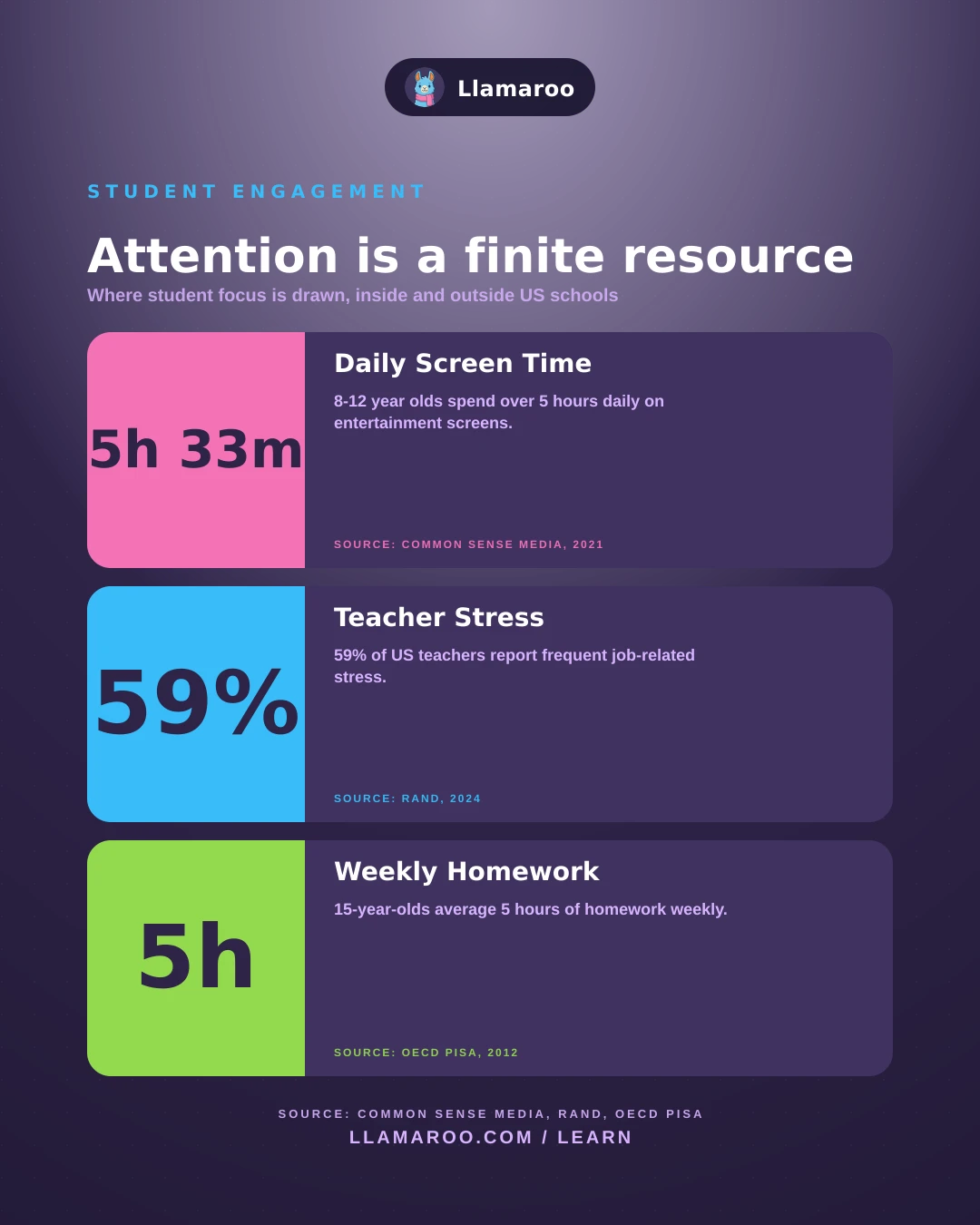
The attention economy of learning
Our kids live in a world that constantly competes for their attention. For 8-12 year olds, daily entertainment screen time averages 5 hours and 33 minutes, according to Common Sense Media, 2021. This isn't inherently bad, but it sets a high bar for what 'engaging' feels like.
- Clear Goals: In hands-on tasks, the goal is often visible and concrete (e.g., 'build this birdhouse').
- Immediate Feedback: A joint fits, or it doesn't. A circuit works, or it sparks. The results are undeniable.
- Purpose and Relevance: Students understand why they are learning something because they are applying it directly.
- Active Learning: It's not passive reception; it's doing, experimenting, and problem-solving.
When these elements are missing from traditional classroom tasks, attention can drift. It's not a lack of motivation, but a lack of a compelling feedback loop. This puts extra pressure on teachers, with 59% of US teachers reporting frequent job-related stress as they try to keep all students engaged.
Common misconception
Can't we just make them pay attention?

Bandit
Bringing purpose to every lesson
The goal isn't to turn every lesson into a woodworking class. It's to infuse the principles of hands-on, purpose-driven learning into all subjects, even in elementaryprimaryprimary classrooms. The U.S. Department of Education emphasizes fostering educational excellence and ensuring equal access, and this includes diverse learning pathways.
- Project-Based Learning: Design lessons around real-world problems that require students to apply knowledge.
- Simulations and Role-Playing: Let students 'do' history or 'act out' science concepts.
- Maker Spaces: Integrate creative building and design challenges, even with simple materials.
- Clear 'Why': Always connect the learning to a tangible outcome or a real-world application. Why does this math matter? Where will this writing be used?
- Quick Feedback Loops: Break down complex tasks into smaller steps, each with clear, immediate feedback. This keeps attention from wandering.
When you design lessons with these principles in mind, you're not just teaching content; you're teaching engagement, resilience, and a love for learning that lasts. You're building a better loop.
Transform any lesson into an engaging, hands-on experience
Llamaroo helps teachers create playable, story-driven lessons from a prompt, voice note, or existing materials, making learning more relevant and engaging for every student.