Actionable insight
Small Steps, Big Impact: Why Explicit Teaching Works
Learning doesn't have to feel like a giant leap. Breaking skills into small, explicit steps is the secret to deeper understanding and lasting confidence.


Have you ever seen a child struggle with a concept, not because they aren't smart, but because the task feels like one giant, overwhelming leap? It's a common frustration for both elementaryprimaryprimary teachers and parents. The good news is, there's a powerful approach that cuts through this: explicit teaching in small, manageable steps.
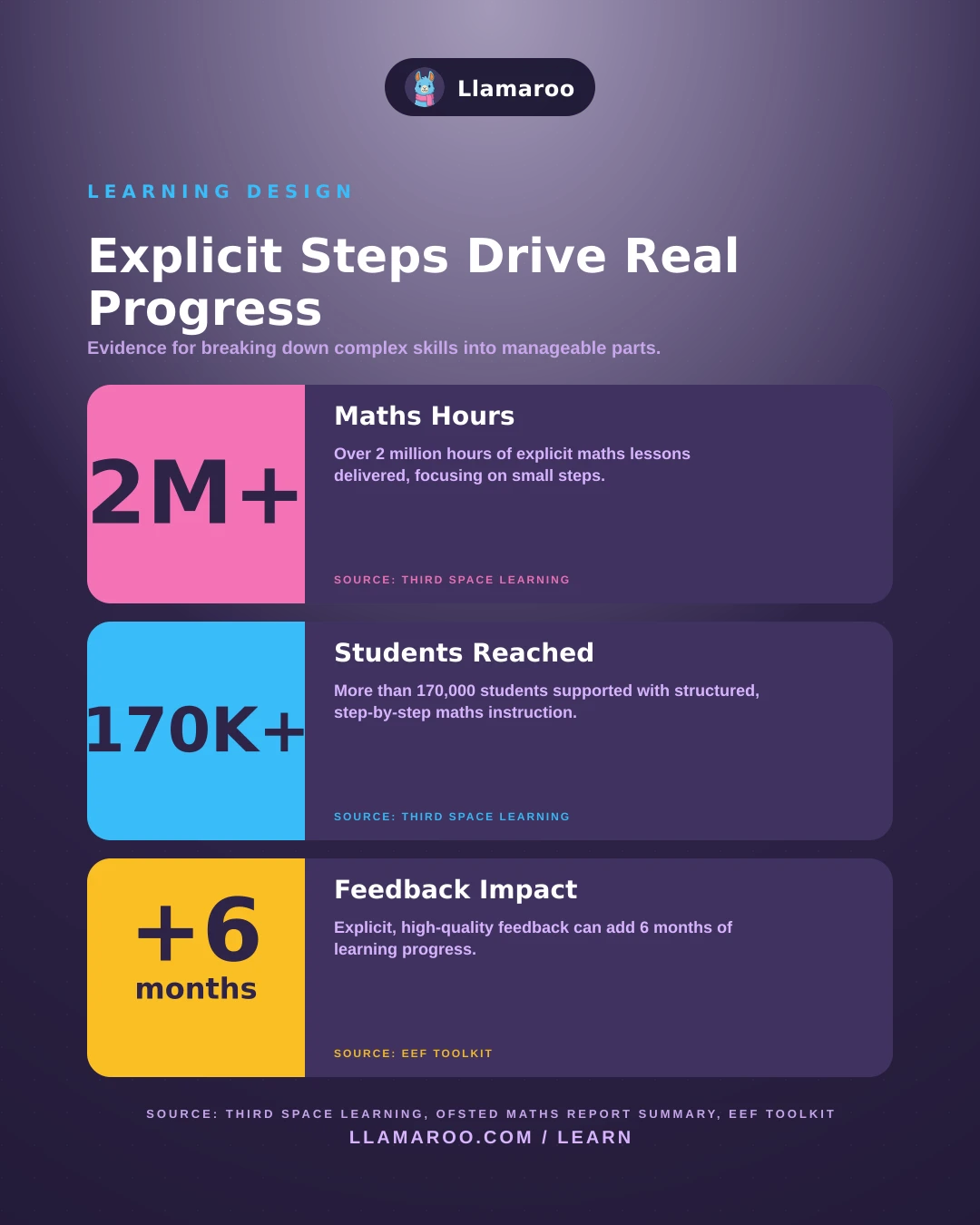
This isn't just about making things easier; it's about making them learnable. For instance, in the UK, the Ofsted Mathematics Subject Report highlights that pupils can't become problem-solvers by simply watching experts. They need problem-solving strategies explicitly taught, sequenced in small steps of declarative, procedural, and conditional knowledge.
Common misconception
Shouldn't kids just figure it out?

Bandit
Pin this. Share this.
Beyond Academics: Future-Proofing Kids
This 'small steps' philosophy isn't just for academic subjects. It applies to critical life skills too. The Child Mind Institute emphasizes 'future-proofing your kids' by equipping them with skills to thrive in rapidly evolving online and social environments. This means explicitly teaching digital literacy, emotional regulation, and resilience—not just hoping they pick it up.
Similarly, a Hechinger Report opinion piece suggests schools should assess students' emotional states, just as they do academic knowledge. This holistic view of learning recognizes that emotional intelligence is a skill that can be broken down and taught, much like any maths concept.
- Clear Goals: What exactly needs to be learned or achieved?
- Tiny Actions: What's the very first, smallest step a child can take?
- Immediate Feedback: How do they know if they're on the right track?
- Visible Progress: Can they see how far they've come and what's next?
Teacher workload
But who has time for all those small steps?

Porto
Making Learning Playable with AI
The principles of explicit, small-step teaching mirror effective game design: clear goals, immediate feedback, and a challenge-skill balance. When a game fails to engage players, like 'Last Flag' did in the gamesindustry.biz report, it's often because it didn't adequately teach its mechanics in manageable steps, leading to player frustration.
For teachers, this means leveraging AI to help design lessons that feel less like a daunting climb and more like a series of achievable quests. AI can help you:
- Break down complex topics into clear, sequential learning objectives.
- Generate scaffolded activities and differentiated practice for each step.
- Create instant feedback mechanisms that guide students immediately.
- Design engaging narratives that connect each small step to a larger learning adventure.
By embracing this approach, teachers can reduce their planning burden while creating more effective and engaging learning experiences. It's about designing for success, one small step at a time.
Transform complex lessons into achievable learning adventures
Llamaroo helps teachers create playable, story-driven lessons that break down any topic into engaging, manageable steps.