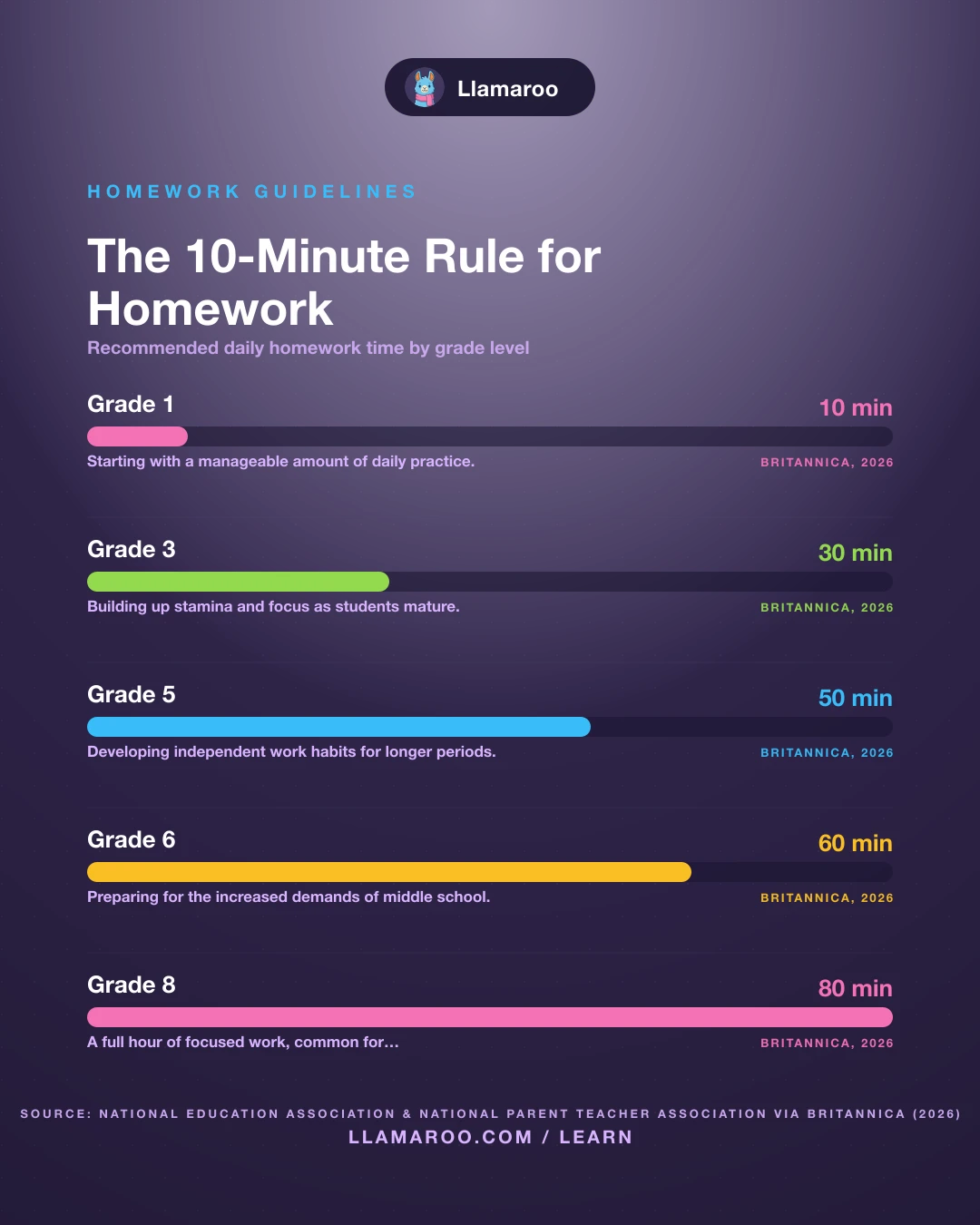
The '10-minute rule' for homework is a widely accepted guideline, often supported by groups like the National Education Association and the National Parent Teacher Association. It suggests that children should have no more than 10 minutes of homework per night for each grade level reached Britannica, 2026. So, a first grader gets 10 minutes, a third grader 30 minutes, and a sixth grader 60 minutes.
But this rule isn't just about limiting workload. It’s a quiet nod to how kids actually learn and stay engaged. Think about it: long, drawn-out tasks often lead to frustration, not deep understanding. Shorter, focused bursts of practice, like those suggested for writing or math instruction on Cult of Pedagogy, are often more effective because they align with a child’s natural attention span.
When a task is short and clear, it’s easier for elementaryprimaryprimary students to start and finish. This builds confidence and provides a sense of accomplishment. It also allows for more immediate feedback, which is crucial for learning. As Character Lab emphasizes, 'Critical Support' — honest, timely feedback — helps students learn more than pure affirmation alone.
Clear Goals: Kids know exactly what they need to do.
Quick Action: Tasks are small enough to start without feeling overwhelmed.
Fast Feedback: They learn if they're on the right track almost immediately.
Visible Progress: Each completed mini-task feels like a small win, fueling motivation.
Long, ambiguous assignments can overload a child's executive function, making it harder to plan, focus, and self-correct. Short, well-designed practice sessions, on the other hand, scaffold these skills naturally.
The practice session
Same 20 minutes, different outcome
The 'Old Way' Homework
0 min
Open long worksheet
Student sees a daunting task, feels overwhelmed, procrastinates.
8 min
Parent intervenes
Frustration builds as the child struggles without clear guidance.
18 min
Task feels endless
Motivation wanes, leading to rushed, ineffective completion.
Playable Practice
0 min
Pick a tiny challenge
Student sees a clear, achievable first step and starts confidently.
8 min
Receive quick feedback
Immediate response guides learning and reinforces correct actions.
18 min
End on a clear win
Session concludes with a sense of accomplishment and visible progress.
How AI can support focused practice (and what to watch for)
For teachers, designing these bite-sized, engaging practice activities can add to an already stretched workload. This is where AI tools can be incredibly helpful. Imagine generating a series of short, interactive practice questions or mini-lessons tailored to individual student needs, complete with immediate feedback.
However, embracing new technology, especially AI, brings important considerations. Schools must carefully vet any new educational technology for student privacy. In the US, this means ensuring compliance with FERPA (Family Educational Rights and Privacy Act). In the UK, schools must adhere to GDPR and the Data Protection Act, ensuring robust safeguarding measures and data protection impact assessments are in place. The principle is the same: student data must be protected.
Quick check
Vetting new tech for schools
Fred
Making practice effective
Effective Practice
3
It's a guideline, adaptable to subjects.
While a guideline, the principle of focused, short bursts of practice applies across subjects. For project-based learning or creative tasks, the time might be more flexible, but the need for clear steps and feedback remains.
AI tools can help create focused activities.
AI can quickly generate short, targeted practice exercises, quizzes, or prompts based on lesson content. This allows teachers to provide differentiated, engaging practice without spending hours on design.
It shifts from monitoring to coaching.
With shorter, clearer tasks, parents can shift from policing homework to being supportive coaches, celebrating small wins and helping their child understand the next step, rather than battling over endless worksheets.
Educate, then build
Turn the next practice task into something your students or your child actually want to finish
Llamaroo helps teachers create playable, story-driven lessons from a prompt, voice note, or existing materials, making practice engaging and effective.