
Friction loop
- 0 min
Open worksheet
Your child sees a pile, not a path.
- 6 min
You start prompting
The task now feels social and emotional.
- 18 min
Everyone is tired
Completion becomes the only win.
Playable explainer
Homework fights are rarely about laziness. They are usually about attention, friction, and feedback loops.


If homework keeps turning into a kitchen-table standoff, the easy story is that your child is lazy, the task is boring, or everyone is too tired. Sometimes those are true. The deeper pattern is gentler than that: most of the time, your child is trying, but the task is asking for attention and giving almost nothing back.
Games rarely make that mistake. A good game tells your child what to do, lets them act quickly, responds right away, and shows the next step before their focus has time to drift.
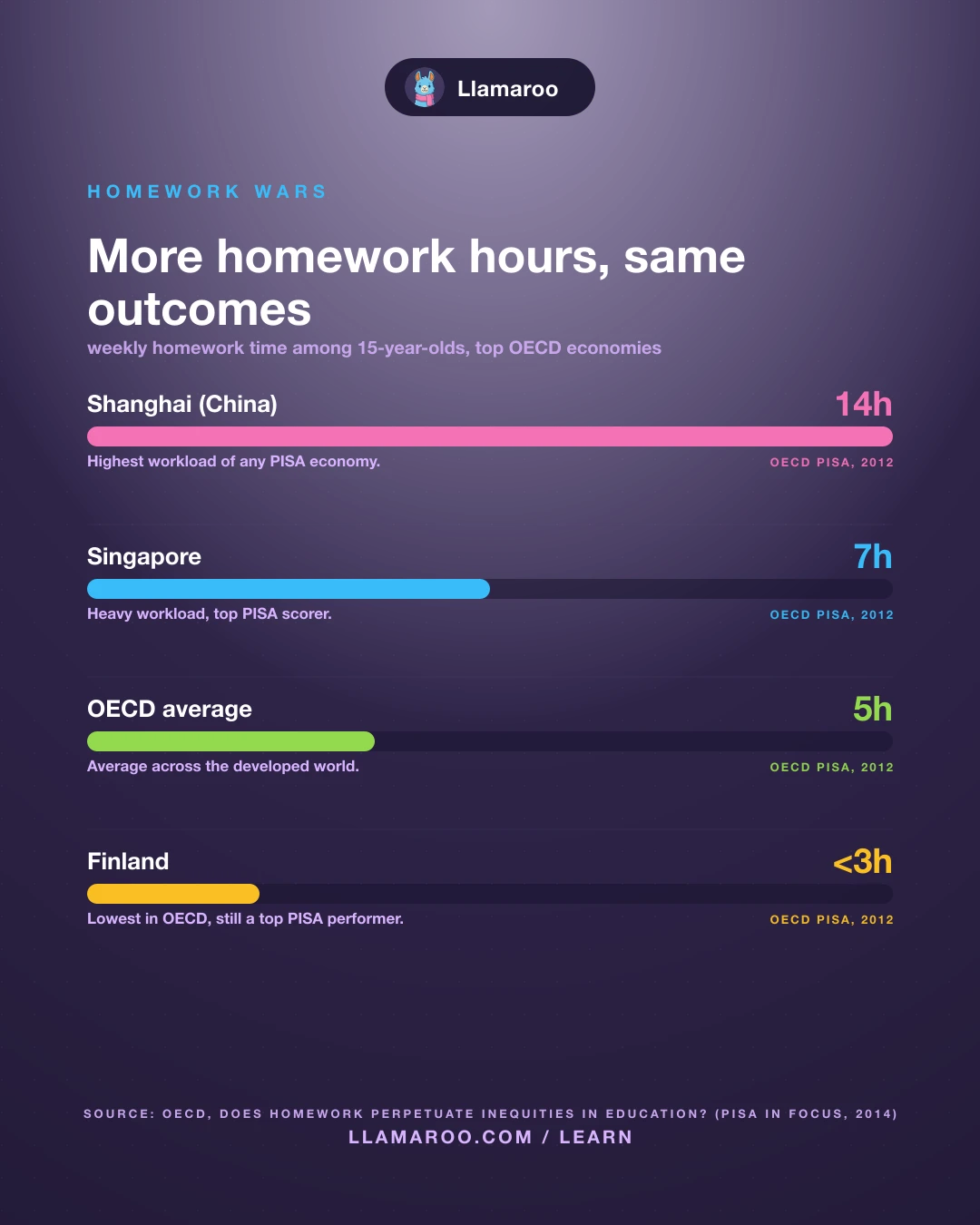
And the international data backs this up. Across OECD PISA 2012 results, 15-year-olds reported a roughly 5-hour-per-week OECD average, but the spread is wild: students in Shanghai-China averaged 14 hours, Singapore 7+, while Finland reported under 3. Finland still scores at the very top. More homework hours do not reliably buy more learning. The shape of the loop matters more than the size of the stack.
Game design and child development research arrive at the same place from different directions. Mihaly Csíkszentmihályi's flow research found that focused engagement requires three things in tight loop: a clear goal, immediate feedback, and challenge calibrated to skill. Typical homework breaks all three. Harvard's Center on the Developing Child describes executive function — your child's mental dashboard for planning, holding attention, and self-correcting — as a skill that is built through scaffolded practice, not exhortation. Long, ambiguous worksheets overload that dashboard. Short, fast-feedback challenges train it.
Quick check
Hippo
Pin this. Share this.
A good game would never ask your child to read six paragraphs before they touch anything. It hands them a small move, lets them try, and teaches through the response. The best classroom and homework practice does the same.
Common misconception
Hippo
| Feature | Homework war | Playable practice |
|---|---|---|
| Experience | ||
| Goal | Finish the worksheet | Beat the next challenge |
| Feedback | Delayed or unclear | Immediate and specific |
| Progress | Invisible until the end | Visible after each step |
| Parent role | Nag and monitor | Coach and celebrate |
You do not need to turn your child into a points chaser. You just need practice where their effort has a visible response.
Your child sees a pile, not a path.
The task now feels social and emotional.
Completion becomes the only win.
Your child sees the first move clearly.
They get a signal before their attention can drift.
The session closes with progress they can feel proud of.
Final hop
Professor Ink
No. The goal is not noise.
The goal is a better loop: clear task, quick attempt, useful feedback, visible progress. Sometimes that looks like a game. Sometimes it looks like a calm checklist with a tiny celebration.
Rewards are tools, not the whole design.
Rewards work best when they reinforce meaningful effort. They work poorly when they cover up a confusing or frustrating task.
You already carry too much design work.
You should not need to spend your weekend turning practice into something your students can start, understand, and finish. Better tooling should carry more of that design burden so you can focus on the relationship in the room.
Llamaroo helps teachers create playable, story-driven lessons from a prompt, voice note, or existing materials.
